
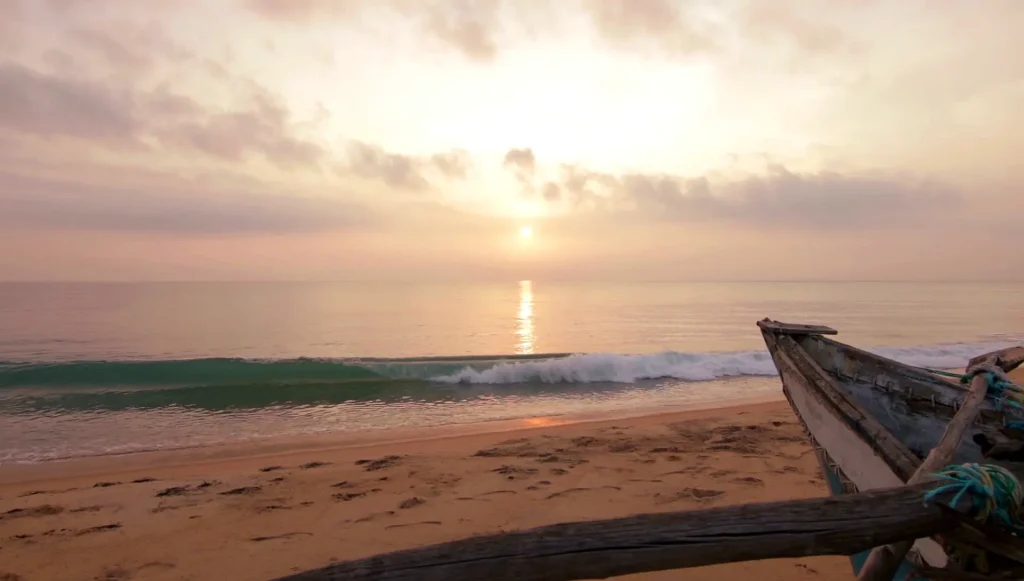
Unawatuna, located in the Galle district of southern Sri Lanka is best known for its pristine beaches that attracts hordes of western tourists and locals alike around the year. It was voted as world’s best beach in 2004 by the Discovery channel. It was relatively unscathed during the Indian ocean tsunami, therefore local tourism has flourished again.
Year round sunshine and tropical weather allow visitors to enjoy an affordable beach vacation any time of the year. Its clear water and moderate strength waves are ideal for many activities including surfing, snorkeling or swimming.
Getting to Unawatuna
The most practical way to reach Unawatuna is via international flights to Colombo, Sri Lanka’s main entry point. Unawatuna is located on the southern coast, approximately 120 kilometers from Colombo, and is usually accessed via Galle.
Once in Colombo, there are three realistic ways to reach Unawatuna, depending on budget, time, and tolerance for inconvenience.
Taxi / Private Transfer
A taxi or private car transfer is the most comfortable and fastest way to reach Unawatuna, especially if you are arriving with luggage or after a long international flight.
The journey typically takes 2.5 to 3 hours, depending on traffic and time of day, and uses the Southern Expressway for most of the distance. Private transfers can be arranged through hotels, travel agents, or transport apps, and are commonly used by tourists.
This option is significantly more expensive than public transport but offers door-to-door convenience and predictable travel time. For short stays or families, it is often the preferred choice.
Bus – Cheaper Option
Bus travel remains the cheapest option, though it requires more patience and flexibility. The main bus station is called Pettah and there is regular bus service from airport. Just take bus number 187 and ask driver to drop you near bus station. Both train and bus station are near to each other.
From Pettah, frequent expressway buses operate toward Galle using the Southern Expressway. These buses are reasonably comfortable, inexpensive (LKR 200), and faster than older coastal routes. Travel time to Galle is typically around 1.5 to 2 hours, depending on traffic and stops.
From Galle, Unawatuna is only 5 kilometers away and can be reached easily by local bus or tuk-tuk. This final leg is short but can feel chaotic during peak tourist periods.
Bus travel is suitable for budget travelers who are comfortable navigating local transport and do not mind occasional delays.
Train
Train travel between Colombo and Galle is popular due to the scenic coastal views, but it is not the fastest or most predictable option. There is no direct train from airport so one needs to go to Colombo city Maradana train station or Colombo Fort. There are regular train services to Unawatuna or Galle. Tickets can be purchased online via official website or at ticket counter for LKR 1100.
Trains run regularly on the Colombo–Galle–Matara route, and the journey usually takes 2.5 to 3 hours. A range of seating options is available, including reserved and unreserved classes. Reserved seats are strongly recommended during weekends and holiday periods.
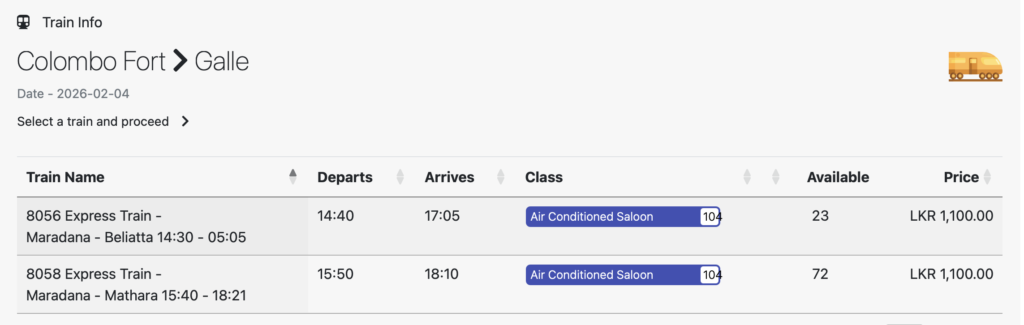
While the train ride can be enjoyable, it requires advance planning and tolerance for crowding, especially during peak travel seasons. From Galle station, Unawatuna can be reached by short bus ride or tuk-tuk.
Train travel is best chosen for the experience rather than efficiency.
| Mode of transport | Cost | Travel time |
| Taxi | $60 to 80 | 2.5 hours |
| Bus | LKR 300 | 4+ hours |
| Train | LKR 1100 | 4+ hours |
Currency and Payments in Sri Lanka
The official currency of Sri Lanka is the Sri Lankan Rupee (LKR), which is used for most day-to-day transactions. While foreign currencies such as US Dollars, British Pounds, and Euros are widely recognized, visitors are generally better served by converting funds into local currency rather than spending foreign currency directly.
Foreign currency can be exchanged at authorized banks, licensed money changers, and major hotels. Exchange rates are usually better for commonly traded currencies such as USD and EUR. Although some shops in tourist areas may accept foreign currency, the rates offered are often unfavorable and should be avoided unless absolutely necessary.
Credit and debit card acceptance has improved significantly in recent years. Most hotels, mid-range restaurants, and established businesses in tourist areas now accept cards. However, cash is still important, particularly for small guesthouses, local eateries, tuk-tuks, beach vendors, and informal services. Visitors should carry a reasonable amount of cash at all times.
ATMs are available in major towns and tourist centers, but availability and withdrawal limits vary by bank and card network. Machines may occasionally be out of service or run out of cash during peak periods. It is advisable to make smaller, regular withdrawals rather than relying on a single large transaction.
As exchange rates and banking conditions can fluctuate, travelers should avoid planning based on historical rates and instead check current conditions close to their travel dates.
Money & Forex Rules, Quick Reference (Sri Lanka)
- Currency: Sri Lankan Rupee (LKR) is used for daily spending.
- Exchange: Change foreign currency only at banks, licensed money changers, or major hotels. USD and EUR are easiest.
- Avoid: Street or informal money changers, illegal and risky.
- Using USD/EUR: Sometimes accepted in tourist areas, but rates are usually poor.
- Cards: Widely accepted at hotels, restaurants, and established shops.
- Cash: Still needed for tuk-tuks, small guesthouses, beach vendors, and local eateries.
- ATMs: Available in tourist areas; limits and cash availability vary. Avoid relying on one large withdrawal.
- Reconversion rule: Exchange certificates are generally not required to convert leftover LKR back to USD/EUR. Small amounts are usually reconverted without issue.
- Best practice: Convert only what you need and rely on cards where possible.
Phone, Internet & Post
Mobile connectivity in Sri Lanka is reliable and easy to set up, and most travelers will not need to rely on hotel Wi-Fi alone.
Several local telecom operators, including Dialog, Mobitel, and Airtel, offer tourist SIM cards with bundled data and local calling. SIM cards are available at Colombo airport and at official carrier stores in major towns. Passport identification is required, and activation is usually completed within minutes at the counter.
Data packages and prices change frequently, so it is best not to plan around specific quotas or costs. In general, tourist SIMs are affordable and sufficient for navigation, messaging, ride booking, and casual browsing. Using a local SIM is still far cheaper and more reliable than international roaming for most visitors. Some travelers also choose international roaming plans or eSIM options, depending on device support.
Free Wi-Fi is available in most hotels, guesthouses, cafés, and restaurants, but connection quality can vary. Mobile data is usually the more dependable option for daily use.
Postal services are functional but rarely used by travelers today. The Sri Lanka Post operates post offices in major towns, including near Galle Fort, and can send postcards or parcels domestically and internationally. For most travelers, however, postal services are an occasional convenience rather than a necessity.
Staying At Hotels, Guesthouses and B&Bs
Unawatuna offers a wide range of accommodation options, from basic guesthouses and B&Bs to mid-range boutique hotels and high-end beach resorts. Prices vary significantly depending on season, location, and proximity to the beach.
Online booking platforms are commonly used to secure rooms, and many properties still allow reservations with minimal upfront commitment. Payment practices vary by property: some accept cards, while others prefer cash settlement at checkout. It is advisable to confirm payment terms in advance, especially at smaller guesthouses.
Money-Saving Tip
Unless you are visiting during peak season, it is often sensible to book only the first one or two nights in advance. Many small hotels and guesthouses are open to extending stays at a lower direct rate once you arrive, as this avoids platform commissions. Negotiated discounts are typically modest but worthwhile
Most guesthouses and B&Bs provide a simple Western-style breakfast for two, which may be included in the room rate or offered at a small additional cost. Quality and variety vary, but breakfast is generally adequate for starting the day before heading out.
Food & Drinks
Most cafés and restaurants in Unawatuna are concentrated along Yaddehimulla Road, a narrow, winding stretch lined with eating options catering to different tastes and budgets. Nearly every place serves a mix of Western staples and Sri Lankan dishes, making it easy for visitors to find familiar food alongside local cuisine.
Over time, the dining scene has become more tourist-oriented. Menus are broadly similar across establishments, with differences mainly in quality, freshness, and setting rather than variety. Prices are higher than local eateries inland but still reasonable by resort-town standards.
For seafood lovers, Unawatuna remains a strong choice. Many restaurants display the catch of the day on ice near the entrance, allowing you to choose your fish before it is cooked. Freshness is usually good, but prices vary depending on season and demand.
What To Expect (Indicative Ranges)
- Coffee and soft drinks: mid-range café pricing
- Tea and local beverages: inexpensive
- Beer and spirits: higher than local standards due to taxes
- Western mains (pizza, pasta, burgers): mid-range
- Seafood dishes: variable, depending on catch and portion size
Groceries and Self-Catering
If you are staying for more than a few days in a self-catering apartment or guesthouse, buying groceries can reduce costs. Supermarkets (Keells, Pagoma, Cargills Food City) in and around Galle are better stocked and more reasonably priced than small convenience stores in Unawatuna.
There is also a local fish market operating early in the morning along the coastal road near Galle, toward the Matara side. It is best visited early and is useful mainly for those with cooking facilities.
Pro Tip
Restaurant quality varies more than menus suggest. A quick walk along Yaddehimulla Road to see what is busy, clean, and freshly stocked is often more effective than relying on reviews alone
Getting Around in Unawatuna
Unawatuna is compact and easy to navigate. Most places can be reached on foot, especially if you are staying near the beach or Yaddehimulla Road.
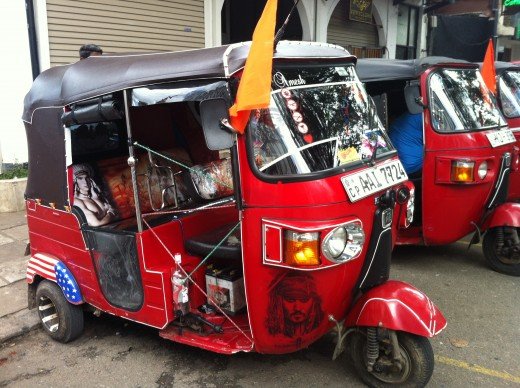
For short trips outside Unawatuna, tuk-tuks are the most convenient option. They are readily available and commonly used for travel to Galle Fort or nearby areas. It is advisable to agree on the fare before starting the ride or use a ride-hailing app where available.
Local buses running toward Galle are frequent, inexpensive, and suitable for short daytime trips, though they can be crowded and are best avoided with luggage.
Scooters and small cars are available for rent, but for most visitors they are unnecessary. Traffic conditions, narrow roads, and limited parking reduce the practical value of self-driving for short stays. Walking combined with tuk-tuks usually covers all transport needs efficiently.
Things To Do In Unawatuna
Unawatuna beach has gentle, low rising waves which make it ideal for swimming and snorkelling. Most beach front establishments provide free sun beds and chairs provided you order something from them. In addition, there is a not so secret jungle beach once secluded, a small patch of the beach which is increasingly being crowded by the tourists. One can also hop a 30-minute bus ride to visit the famous beaches of Hikkaduwa.
If you are ever tired of sunbathing at the beach, here is a list of places that can be visited.
Japanese Peace Pagoda
Japanese Peace Pagoda is perched on Rumassala hill about 3 kilometers from Unawatuna beach. It can be reached by road by tuk-tuk took (LKR 500) or moderate trek through the woods. Like all Buddhist temples, it is very peaceful. This one is one of 80 peace pagoda built by the Japanese Nipponzan-Myōhōji order. You will have to remove shoes while entering pagoda but it is worth the effort. Women may have to wear at least knee length skirt. They loan a free sarong style wrap around if you are not modestly dressed.
They also have an evening prayer meet at 5 pm which is a unique experience in itself. View of the sunset overlooking Galle fort is amazing from this place.
The Galle Fort
Galle fort was built by the Portuguese in the late 16th century and later extensively fortified by the Dutch in the mid 17th century. Currently, it has been declared as UN world heritage site and undergone a major renovation. The entire fort has been conserved as per UN guidelines. Now, it houses a maritime museum, restored churches and several upscale hotels, restaurants, spas and boutiques. The entire place is dotted with restored 18th-century buildings along cobbled stone pathways.
There are few upscale hotels including Amangalla hotel and Galle Fort Hotel. In addition, there are few expensive, luxury villas available for daily or weekly rentals. There are several excellent cafes and restaurants serving a variety of food. I would recommend trying, at least, a few during afternoon or evening.
There is also an old clock tower and a lighthouse within the fort compound.
Whale Watching Trips
There are several tour companies advertising whale watching trip starting from LKR 4000 to 8500 (US$ 30 to $60) which includes hotel transfers, free breakfast and 3 to 5 hours in sea watching whales and dolphins.
I am personally against chasing whales and disturbing them for touristic pleasure, but if must go choose the biggest boat operated by the Sri Lankan navy on weekends. As per their website charges are $60 per person. If you are prone to sea sickness, please avoid this trip or take Avomine tablets to prevent nausea and headaches.
Best Season vs Avoid Season For Marine Life Watching
Whale watching along Sri Lanka’s southern coast is highly seasonal.
Best season:
December to April: sea conditions are generally calmer, and sightings are more likely. This is when most operators run regularly.
Avoid season:
May to September: the southwest monsoon brings rough seas and unpredictable weather. Trips are frequently cancelled, and even when they run, conditions can be uncomfortable and unsafe.
Outside the peak season, travelers should treat whale-watching trips as low-probability, high-discomfort activities and plan accordingly.
Surfing, Snorkeling & Diving
There are several beaches in Unawatuna, Mirrisa and Hikkaduwa that have ideal conditions for surfing. The ocean swell is 3 to 5 feet (1 to 1.5 meters) with a regular frequency which is ideal for beginner to experienced surfers alike. Surfboards can be hired for LKR 1000 to 2000 while group lessons are provided from USD 40 onward. The best season is from December to April when water is clear. There are several in Unawatuna including Unawatuna Dive Center which is PADI certified.
Spa, Yoga and Cooking Classes
There are numerous Ayurvedic yoga and spa centers in Unawatuna. Most spas would offer yoga classes for LKR 800 per hour. A typical spa menu will set you back by LKR 3000 to 5000 depending on the treatment offered. For a luxury experience, try upscale Spa Ceylon which has several branches in Sri Lanka.
One may sign up for cooking classes which include a visit to the local fish market, explaining the use of local spices and cooking lessons all for $25 onwards.
Annoyances, Dangers, and Tourist Traps
Sri Lanka is generally a safe destination for travelers, including solo visitors and women traveling alone. Violent crime against tourists is rare. Most issues visitors encounter are minor annoyances or opportunistic behavior rather than real danger.
One common irritation is pushy tuk-tuk drivers, particularly in tourist areas. Some may approach aggressively or insist on offering services. A firm refusal usually works. Agree on fares in advance or use app-based services where available.
Occasionally, visitors may encounter overcharging at beachside restaurants, especially in heavily tourist-oriented areas. This can include inflated prices, duplicate menus, or items added to the bill that were not ordered. Checking the menu carefully and confirming prices beforehand reduces the risk.
Unwanted attention can occur, particularly toward foreign women, such as being followed briefly or stared at. These incidents are usually non-confrontational and short-lived, but awareness and avoiding isolated areas after dark is sensible, as in any unfamiliar destination.
Natural Irritants and Wildlife
Mosquitoes are widespread across Sri Lanka and can be a persistent nuisance, especially near the coast and during humid periods. Carrying a reliable insect repellent is strongly recommended.
If trekking or walking through freshwater areas, creeks, or dense vegetation, leeches can be an irritant. Wearing protective footwear and socks helps, and carrying salt is a common local remedy if needed.
Visitors may occasionally see monitor lizards near water bodies or gardens. Despite their intimidating appearance, these animals are harmless if left alone and tend to avoid humans. They are a protected species and should not be disturbed.
This article is Written by Kamal Mohta. Originally published on HubPages (AUGUST 12, 2017), updated and owned by the author. Copyright belongs to author, published with permission.