
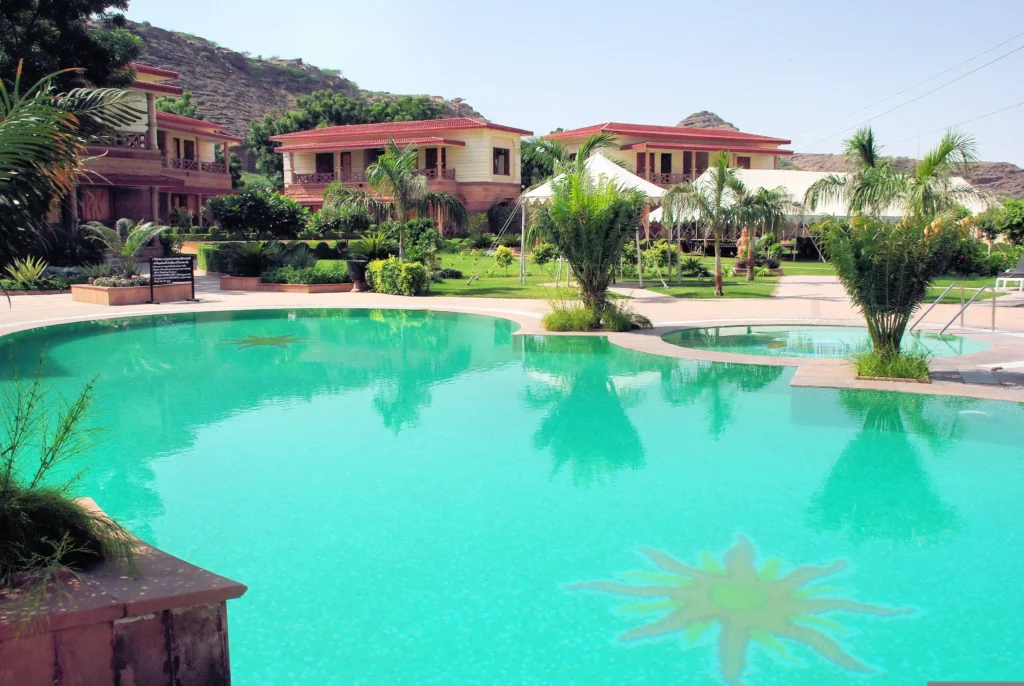
Let’s dive deeper into hospitality playbook used in remote luxury properties in India and world. A quiet revolution is reshaping high-end travel across India and beyond. Luxury is no longer defined by marble lobbies, chandeliers, and proximity to airports. The new aspiration lies elsewhere. Away from cities. in nature, in solitude, in rituals that restore a sense of equilibrium. This is remote luxury: hospitality that chooses distance as its competitive advantage.
Geographic depth is wide and landscapes various. Travelers are seeking grounded experiences over grandeur, context over spectacle, and meaning over opulence everywhere, from the ryokans of Japan to the cliffside sanctuaries of Amanpulo, from Costa Rica’s forest retreats to the lake-view villas in Udaipur.
India, now in the middle of a profound wealth and lifestyle shift, is emerging as one of the most interesting markets for this category. Rising incomes, changing professional lives, deeper digital exposure, and a search for emotional rest have created an inflection point. Remote luxury is no longer a niche experiment; it is a category on the brink of becoming mainstream.
This playbook is designed to give founders, property owners, and operators a detailed, analytical view of this landscape. It will analyze with clinical precision not only the shifting landscape but ts customers, its numbers, its opportunities, and its hidden fragilities.
The Landscape: Understanding the Forces Shaping Remote Luxury
Remote luxury sits at the intersection of four major global shifts. India is experiencing all four simultaneously, making it uniquely positioned for rapid category expansion.
1. A Global Recalibration of Luxury
Across affluent markets, the meaning of luxury has shifted from display to discretion.
The common underlying logic: Time, privacy, and silence have become the true luxury goods. This shift created a new benchmark for hospitality: spaciousness, personalization, cultural grounding, and environmental sensitivity not maximalist architecture.
2. Rising Living Standards In India As Driver Of Remote Luxury Hospitality
India’s luxury travel market has changed more in the last five years than the previous twenty. This rise in disposable income has directly fueled remote luxury demand.
- Tier 2 & Tier 2.5 cities are producing HNIs at scale.
- The aspirational class (₹20–40 lakh annual income) now prioritizes premium travel over consumer goods.
- First-generation entrepreneurs and professionals are choosing wellness-centric travel.
- Multi-generational family travel is moving from hotels → villas → experiential retreats.
3. Digital Exposure & Design Awareness
Instagram, Pinterest, and global travel content have dramatically increased sensitivity to design. A boutique property in Rishikesh or Goa is now compared not to local peers, but to Bali, Tuscany, Ryokans or Patagonia.
Design awareness has become a baseline, not a differentiator. What differentiates is the story, the rituals, the emotional coherence of the place
4. COVID as a Permanent Catalyst
The Indian hotels and motels industry experienced very strong growth after Covid which was further aided by streamlined, digital first visa issuance to international tourists. During Covid remote luxury travel became mainstream when it became the safest form of travel but the psychological shift remained even after restrictions vanished.
- Families discovered the joy of privacy.
- Professionals discovered the restorative power of silence.
- Millennials discovered slow travel.
- Brands discovered the value of curated wellness
The Market: Who is Driving the Growth?
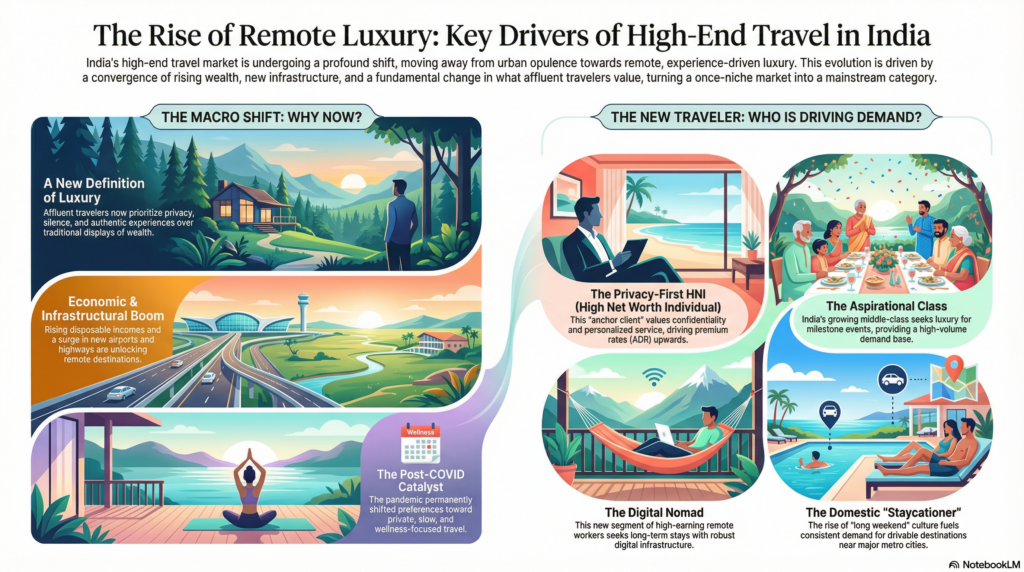
HNI, Privacy First Cohort
• Values confidentiality, safety, and personalized service
• Are highly influenced by design and storytellingTravels with staff (nanny, driver, chef support)
• Prefers minimal human contact unless requested
• Spends freely if experience quality is assured
This segment drives ADR upwards and becomes the “anchor clientele” for remote properties

Primary triggers:
• Time
• Privacy
• Control
• Seamless Service
The Aspirational Cohort
• Seek luxury as a reward for milestone achievements
• Are highly influenced by design and storytelling
• Expect exceptional F&B
• Demand IG moments without feeling overly curated
This is the volume segment, filling shoulder days and providing strong direct bookings. Uncovers a realm of opportunities.

The Influencer Cohort
• Short stays
• High photo/video consumption
• Exceptional storyteller with reach
• Low long-term loyalty
They are not the most profitable customers, but they amplify brand visibility.

International FIT Cohort
• Long stays
• Cultural authenticity
• Silence retreats, Spirituality
• Nature immersion, Yoga, Ayurveda
Their expectations align well with the remote luxury philosophy: slow, intentional, grounded.

Under the Hood
Below is a transparent, data-driven model of a 6-key premium remote luxury property in India — the category sweet spot. This is not theoretical. It reflects real-world performance across Rajasthan, Uttarakhand, Goa hinterlands, and parts of Himachal.
A. Property Overview
A six room villa in popular tourist destination in India. Metrics assumptions are aligned with industry standards at the time of writing of this article.
B. Revenue Model (Annual)
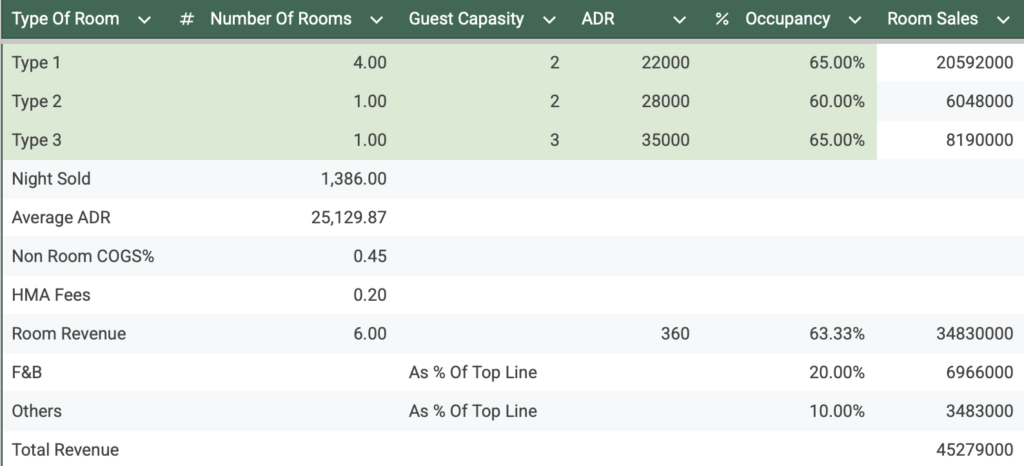
Room revenue is taken at 65% occupancy. It is normal for well run hotels to comfortably achieve this mark in high tourist area such as Goa, Rajasthan or hill stations. Driving distance from metro cities is an important factor in choosing specific location.
1. Room Revenue
6 rooms × 365 days × 65% occupancy × ₹25,000  = ₹3.5 Cr

2. Ancillary revenue
30% of top-line
Therefore:
Total Revenue = ₹3.56 Cr / 0.30  = ₹1.05 Cr
C. Expanse Model
New wpDataTable
D. NOI (Net Operating Income)
Revenue: ₹4.52 Cr
OPEX:    ₹3.04 Cr
--------------------
Theoretical NOI: ₹1.48 Cr

But luxury hospitality demands realism.
After normalizing for seasonality, founder oversight, and experience delivery:

Practical NOI = ₹1.25–1.6 Cr (25–32% NOI margin)

This aligns with the top-performing remote luxury boutiques in India.
E. Case-Study Charts
- Revenue Composition – Pie Chart
- Payroll Distribution – Bar Chart
- Guest Behavior Chart
- Sensitivity Chart
- Staff to Guest Ratio
Final Thoughts & Conclusion
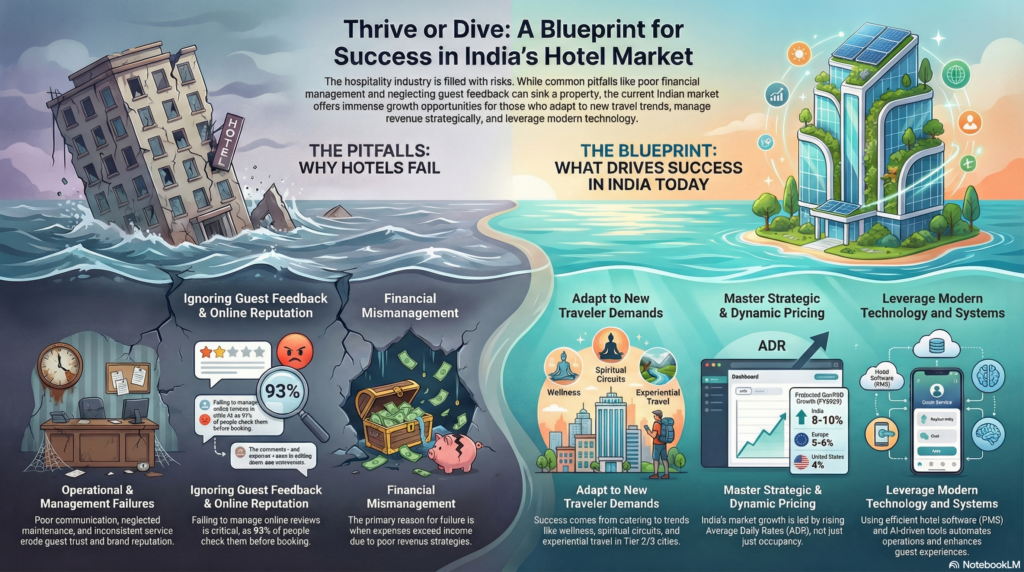
The operational profitability of a remote luxury property hinges entirely on disciplined strategy, not luck.
The single biggest lever you control is ADR, not occupancy. You cannot offset the magnified costs of remote logistics and infrastructure by filling more rooms at a lower rate,. ADR resilience is the core engine, positioning India’s high-end assets for growth that outpaces volume-driven markets,.
To realize and defend that premium price, sustained brand validation is 100% necessary. Marketing, PR, and content are the required cost of entry for premium pricing. Luxury magazine placements aren’t optional vanity metrics; they are essential external proof that justifies the rate structure and establishes exclusivity.
Achieving true margin resilience means relying heavily on ancillary revenue streams. That target of 30% non-room revenue is possible, but it is not automatic. It requires building meticulously crafted guest rituals and immersive, cultural experiences that guests are willing to spend more on, moving the focus beyond opulence to authenticity and curated moments,,.
Finally, the systems beneath the surface must support this structure. Staff depth is a major hidden cost in remote settings. Promoting multirole staff utilization builds operational resilience, lowers unnecessary overhead, and strategically trains your existing team with broader knowledge, mitigating the chronic lack of skilled staff often found away from metro hubs,,.
In summary, success in remote luxury requires balancing a high price with radical consistency. ADR defines the ceiling; systems and intentional experiences define the profit floor.