

- 1. What is an STR profit calculator?
- 2. Start with revenue: ADR and occupancy
- 3. Why operating costs are often underestimated
- 4. Understand operating surplus, not just revenue
- 5. Operating break-even occupancy
- 6. Sustainable break-even: An often-missed calculation
- 7. Financing and EMI: Keep them separate
- 8. Location and seasonality matter
- 9. Worked example: Evaluating a small STR property
- 10. How to use the Hosthelper STR Operating Cost Calculator
- 11. The most important question: Is the property worth operating?
Owning a holiday home, serviced apartment, guesthouse or short-term rental property can appear financially attractive. A property that earns ₹3,000 per night and is occupied for 20 nights a month generates ₹60,000 in monthly room revenue. At first glance, this may seem like a healthy return.
But revenue is not profit.
The property has to be cleaned, maintained and managed. Electricity bills can increase substantially during summer. Guests consume amenities, linen needs regular washing and replacement, and bookings may come through platforms that charge commissions. There may also be rent, caretaker salaries, repairs, internet charges, marketing expenses and other costs.
Once these expenses are accounted for, the actual financial performance can look very different from the initial estimate.
This is why anyone considering a short-term rental (STR) business should calculate its operating economics before committing to a property or making investment decisions.
A structured STR profitability calculation helps answer five important questions:
- How much revenue can the property realistically generate?
- What will it cost to operate the property?
- At what occupancy level will the property break even?
- How much money will remain after operating expenses?
- Is the property generating enough surplus to maintain and replace its assets over time?
This guide explains how to calculate short-term rental profitability in the Indian market and how to use the free Hosthelper STR Operating Cost Calculator to evaluate a property.
1. What is an STR profit calculator?
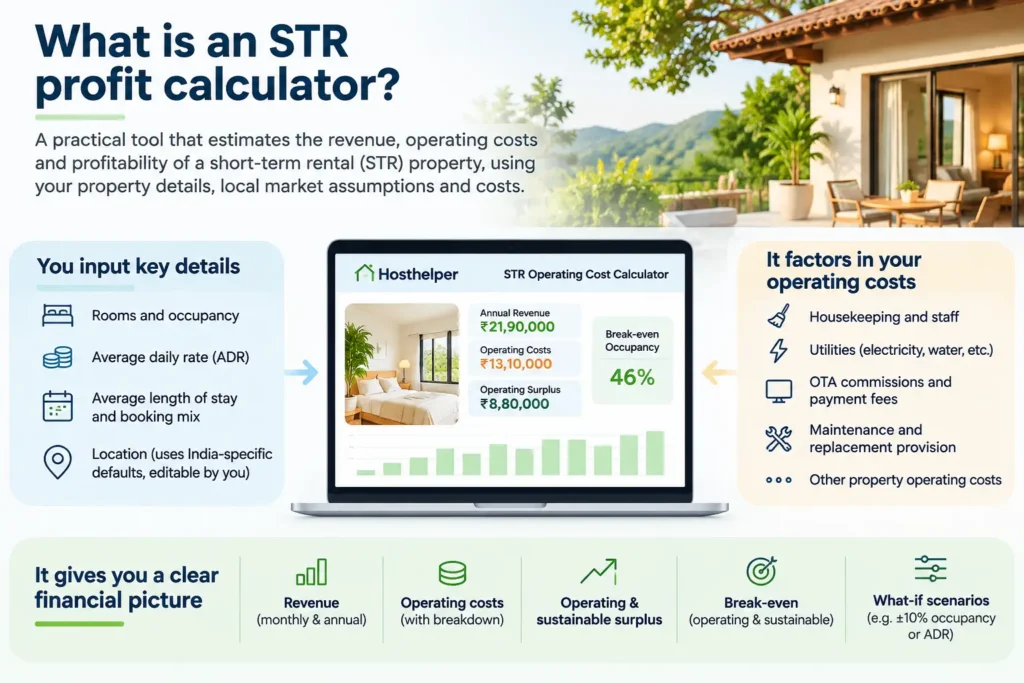
An STR profit calculator is a financial planning tool that estimates the revenue, expenses and potential surplus of a short-term rental property.
It is relevant to several types of accommodation businesses:
- Holiday homes and vacation rentals
- Serviced apartments
- Homestays
- Independent guesthouses
- Boutique accommodation
- Individually operated rooms and small properties
Unlike a conventional long-term rental calculation, an STR model must account for changing occupancy, nightly rates, guest turnover and the costs of servicing each booking.
For example, a long-term rental property may have one tenant paying rent every month. A short-term rental property could accommodate ten different bookings in the same month. Each booking creates additional housekeeping, laundry, amenities and administrative work.
The financial model therefore needs to consider both fixed and activity-based expenses.
A useful STR calculator should help the owner understand not just how much money the property might earn, but also what it takes to generate that revenue.
2. Start with revenue: ADR and occupancy
Two variables have a particularly strong influence on short-term rental revenue:
Average Daily Rate (ADR)
ADR is the average room rate earned for each occupied night.
For example, if a property earns ₹30,000 from ten occupied room nights, its ADR is ₹3,000.
ADR should reflect the actual realised room rate after discounts, rather than simply the advertised rate.
Occupancy
Occupancy measures the proportion of available room nights that are occupied.
Suppose a property has one room available for 30 days and sells 15 nights. Its occupancy is 50%.
For a property with multiple rooms, the calculation considers the total available room nights.
Calculating monthly room revenue
Monthly room revenue = Number of rooms × Available days × Occupancy × ADR
Consider a small property with:
- 3 rooms
- 30 available days
- 45% occupancy
- ₹2,500 ADR
The property has 90 available room nights. At 45% occupancy, it sells approximately 40.5 room nights.
Estimated monthly room revenue is approximately ₹1,01,250.
This is gross room revenue before operating expenses and applicable taxes.
An important distinction: revenue estimates are only as reliable as their assumptions. A property’s actual ADR and occupancy depend on its location, season, competition, property quality, reviews, distribution and management.
A high advertised nightly rate does not necessarily translate into a high realised ADR.
3. Why operating costs are often underestimated
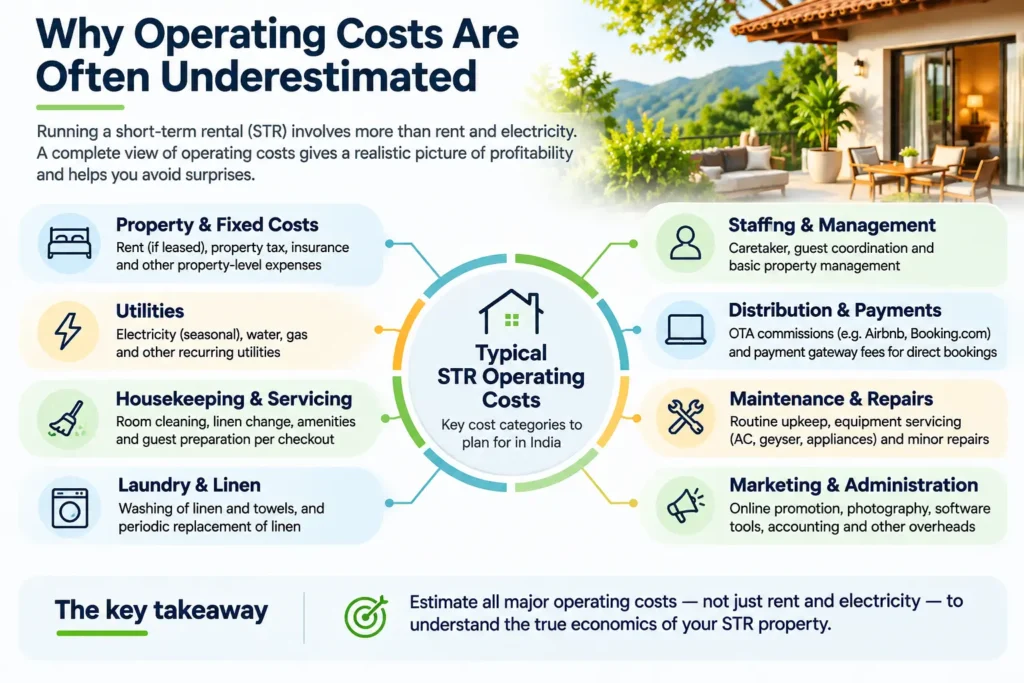
Many new STR operators estimate revenue carefully but underestimate the cost of running the property.
A property may appear profitable when only rent and electricity are considered. However, the actual operating cost structure is considerably broader.
The following categories deserve attention.
Property and occupancy-independent costs
These are expenses that generally continue even when the property has no guests.
Rent
For leased properties, rent is usually one of the largest fixed expenses. It needs to be included even when occupancy is low.
For owned properties, rent is not a cash operating expense. However, the economic value of the property can be considered separately as an opportunity cost.
Internet
A reliable internet connection is increasingly expected by guests. This is generally a recurring property-level expense.
Property tax and insurance
Depending on the ownership and rental arrangement, these costs may be borne by the owner or operator. They should be included where applicable.
Utilities
Electricity can be a significant expense, particularly in destinations with hot summers or cold winters.
Air conditioning, geysers, refrigerators, water pumps and other appliances contribute to consumption.
A single annual average may conceal substantial seasonal differences.
For example, a property in Rajasthan may have significantly higher electricity consumption during summer than during the winter months.
Water costs can also vary depending on the destination, source of supply and number of guests.
Housekeeping and guest servicing
Every guest checkout creates work.
Typical activities include:
- Cleaning bedrooms and bathrooms
- Changing linen and towels
- Replenishing toiletries and amenities
- Preparing the property for the next guest
- Checking the room for damage or missing items
A property that has frequent short stays may incur substantially higher servicing costs than one with longer average stays.
This is why average length of stay matters.
If a property sells 60 room nights through 30 two-night stays, it has approximately 30 checkouts. If the same 60 room nights are sold through ten six-night stays, it has only ten checkouts.
The room revenue may be similar, but the housekeeping and guest turnover costs can be very different.
Caretaker and property management
Small properties may rely on a caretaker who handles guest coordination, basic maintenance and routine property management.
The salary is a recurring expense.
However, the operator should avoid double-counting housekeeping if the caretaker’s role already includes routine cleaning.
Laundry and linen
Linen and towels need to be washed after guest stays. Laundry can be handled internally or outsourced.
The cost depends on:
- Number of checkouts
- Linen and towel consumption
- Kilograms processed per checkout
- Outsourced or in-house processing rates
Linen replacement is a separate long-term cost and should not be confused with routine laundry processing.
Maintenance and repairs
Maintenance expenses are easy to overlook because they do not occur in equal amounts every month.
Typical expenses include:
- Air-conditioning servicing
- Geyser maintenance
- Plumbing and electrical repairs
- Furniture repairs
- Water purifier servicing
- Appliance maintenance
A reasonable financial plan should make an allowance for recurring annual maintenance rather than assuming that equipment will operate indefinitely without cost.
Distribution and booking costs
Bookings through online travel agencies (OTAs) can attract commissions.
Direct bookings may avoid some OTA commissions but can still incur payment gateway charges, marketing costs and customer acquisition expenses. See Hosthelper’s guide to booking direct and OTA fees for related booking considerations.
The operator should calculate these costs according to the actual booking mix.
For example, a property receiving 70% of bookings through OTAs and 30% directly should not apply the OTA commission to all revenue.
Marketing and administration
Additional costs may include:
- Online advertising
- Photography
- Website expenses
- Accounting and bookkeeping
- Channel management software
- Booking engine subscriptions
- Staff and administrative support
Some of these expenses are optional, but they should not automatically be assumed to be zero in a long-term business plan.
4. Understand operating surplus, not just revenue
Once revenue and recurring operating expenses have been estimated, the next step is to calculate operating surplus.
Operating surplus = Gross room revenue − Operating expenses
Suppose a property generates ₹1,01,250 in monthly room revenue and incurs ₹75,000 in operating expenses. Its monthly operating surplus is ₹26,250.
This is the amount remaining before considering financing obligations and long-term asset replacement.
It is important not to confuse operating surplus with the owner’s final take-home income.
If the property has a loan, EMI payments affect the cash available to the owner. If furniture, appliances and equipment need replacement, the operator must also plan for those future expenses.
These are separate considerations.
5. Operating break-even occupancy
One of the most useful metrics for an STR operator is break-even occupancy.
It answers a straightforward question:
What percentage of available nights must I sell to cover my operating costs?
Suppose a property has:
- 2 rooms
- 30 available days
- ADR of ₹3,000
- Monthly operating costs of ₹90,000
Total available room nights are 60.
At 100% occupancy, the property would generate ₹1,80,000 in room revenue.
Ignoring any additional variable costs for this simplified illustration, operating break-even occupancy would be 50%.
In an actual STR model, variable expenses such as OTA commissions, housekeeping, amenities and laundry increase as occupancy increases. Therefore, a proper break-even calculation must account for the relationship between revenue and occupancy-sensitive costs.
This is why simply dividing fixed expenses by maximum possible revenue can produce an inaccurate result.
The distinction between current occupancy and break-even occupancy is particularly useful.
If the property’s current occupancy is 35% and operating break-even is 55%, the operator has a 20-percentage-point gap to close.
That gap could potentially be addressed through better pricing, improved distribution, stronger marketing, cost reduction or a combination of these measures.
6. Sustainable break-even: An often-missed calculation
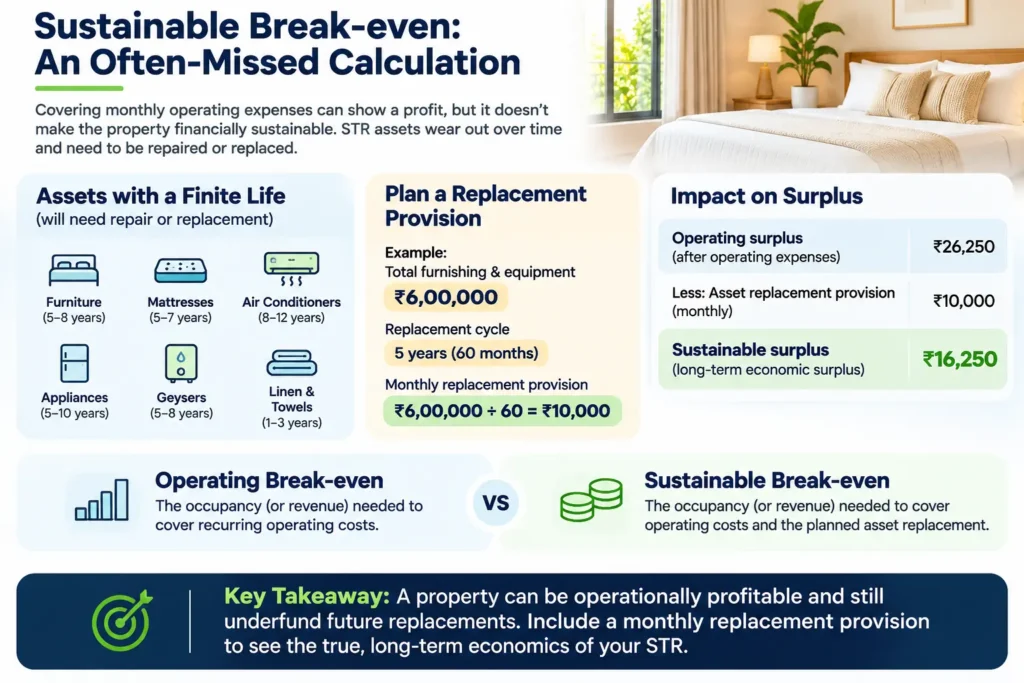
Covering monthly operating expenses does not necessarily mean the property is financially sustainable.
Furniture, mattresses, appliances, air conditioners, geysers, linen and other assets have finite useful lives.
These assets eventually need repair or replacement.
If an operator ignores these future expenses, the property may appear profitable while gradually consuming its own assets.
Consider a property that requires ₹6 lakh in room furnishings and equipment, with an expected replacement cycle of five years.
A simple monthly replacement provision would be:
₹6,00,000 ÷ 60 months = ₹10,000 per month.
This is a planning allowance, not an immediate cash payment or accounting depreciation entry.
The sustainable surplus calculation is:
Sustainable surplus = Operating surplus − Asset replacement provision
If monthly operating surplus is ₹26,250 and the replacement provision is ₹10,000, sustainable surplus is ₹16,250.
The property is generating a positive operating surplus, but its sustainable economic surplus is lower.
Operating break-even covers recurring operating costs.
Sustainable break-even covers recurring operating costs and the planned provision for asset replacement.
This distinction helps an operator avoid treating the entire operating surplus as money available for personal withdrawal.
7. Financing and EMI: Keep them separate
Many STR properties are purchased or renovated using borrowed capital.
Loan EMI payments affect monthly cash flow, but they should not simply be added to operating expenses.
An EMI normally consists of principal repayment and interest.
Principal repayment is a financing cash outflow, not an operating expense. Interest is a financing cost.
For financial planning, it is useful to see:
- Operating surplus before financing.
- Sustainable surplus after asset replacement provision.
- EMI cash outflow.
- Cash remaining after EMI.
This separation helps answer two different questions:
- Is the property economically viable as an operating business?
- Can the property meet its monthly financing obligations?
A property can have positive operating economics but negative cash flow after EMI. Conversely, a property with no loan may have positive monthly cash flow while still requiring substantial future asset replacement.
These should not be confused.
8. Location and seasonality matter

STR performance varies considerably across India.
A property in Jaipur may have a different demand pattern from one in Goa, Varanasi, Udaipur, Manali or Bengaluru.
Demand can be influenced by:
- Tourism seasons
- Religious and cultural events
- Corporate travel
- School holidays
- Weather
- Local festivals
- Weekend and weekday travel patterns
A single national ADR or occupancy assumption is therefore not sufficient for a serious property evaluation. The Hosthelper STR Operating Cost Calculator includes destination-based reference defaults for 39 locations.
These defaults are intended to provide a starting point for planning, not a guarantee of actual market performance.
An important qualification is that hotel ADR references and estimated STR occupancy are not the same as verified short-term rental market observations. The calculator’s occupancy estimates use an indicative heuristic based on hotel occupancy, with a reduction of 25 percentage points.
Users should replace these reference assumptions with their own research wherever reliable local STR data is available.
Seasonality also affects operating costs.
For example, electricity consumption may be significantly higher during summer. A property should therefore not automatically assume that its utility expenses will remain constant throughout the year.
9. Worked example: Evaluating a small STR property
Consider a hypothetical two-room property.
The operator uses the following assumptions:
| Input | Assumption |
|---|---|
| Number of rooms | 2 |
| ADR | ₹2,500 |
| Occupancy | 45% |
| Available days | 30 |
| Average stay | 2 nights |
| Monthly room revenue | ₹67,500 |
The property sells approximately 27 room nights per month.
At an average stay of two nights, this translates into approximately 13.5 checkouts.
The operator must now account for rent, electricity, internet, housekeeping, amenities, laundry, caretaker expenses, maintenance, OTA commission and other costs.
The resulting operating surplus depends on the actual expenses and booking mix.
The operator should then deduct a monthly asset replacement provision to calculate sustainable surplus.
Finally, if the property has an outstanding loan, EMI cash outflow should be shown separately.
This example illustrates why two properties generating the same room revenue can have very different financial outcomes.
A property with a lower rent commitment, longer average stays and efficient servicing may perform better than another property with a higher ADR but more frequent guest turnover and higher fixed expenses.
The purpose of the calculation is not to produce an attractive number. It is to understand the economics before committing money.
10. How to use the Hosthelper STR Operating Cost Calculator
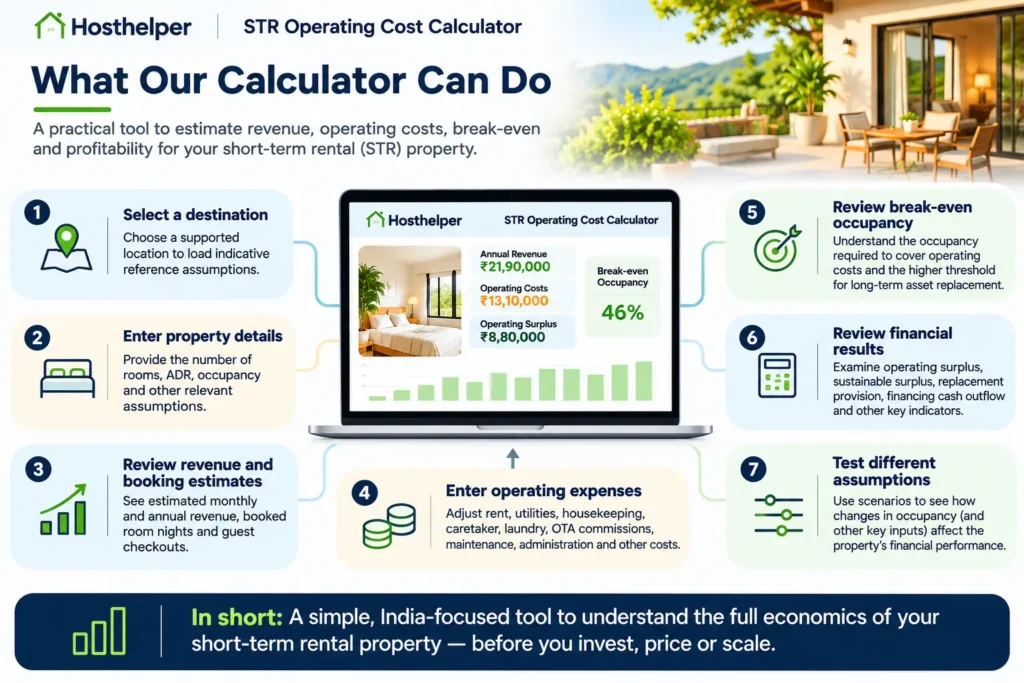
The Hosthelper STR Operating Cost Calculator is designed to help property owners and prospective operators estimate the financial performance of a short-term rental.
You can use it to:
- 1. Select a destination. Choose a supported location to load indicative reference assumptions.
- 2. Enter property details. Provide the number of rooms, ADR, occupancy and other relevant operating assumptions.
- 3. Review revenue and booking estimates. The calculator estimates monthly and annual room revenue, booked room nights and guest checkouts.
- 4. Enter operating expenses. Adjust rent, utilities, housekeeping, caretaker, laundry, OTA commissions, maintenance, administration and other costs.
- 5. Review break-even occupancy. Understand the occupancy required to cover recurring expenses and the higher threshold required to fund planned asset replacement.
- 6. Review financial results. Examine operating surplus, sustainable surplus, replacement provision, financing cash outflow and other financial indicators.
- 7. Test different assumptions. Use the available scenarios to understand how changes in occupancy affect the property’s estimated financial performance.
The calculator is intended as a planning tool. Its estimates depend on the assumptions entered and the quality of the available reference data.
It does not guarantee occupancy, revenue or investment returns.
11. The most important question: Is the property worth operating?
A short-term rental should not be evaluated solely by its gross revenue or advertised nightly rate.
A property generating ₹1 lakh in monthly room revenue may be less attractive than another generating ₹80,000 if the first has substantially higher operating costs, guest turnover and capital requirements.
A proper evaluation should consider:
- Realistic ADR and occupancy
- Total recurring operating expenses
- Guest servicing costs
- Distribution and acquisition costs
- Operating break-even
- Asset replacement requirements
- Financing obligations
- Seasonal variations
- The opportunity cost of the property
The objective is to understand whether the property can generate a sustainable surplus, not merely whether it can generate bookings.
For an existing operator, this analysis can identify opportunities to improve pricing, reduce unnecessary expenses and improve booking economics.
For someone considering a new property, it can help establish the occupancy and revenue levels required before making a financial commitment.
Start with the numbers, not the assumptions.
Use the free Hosthelper STR Operating Cost Calculator to estimate the operating economics of your property, adjust the assumptions and understand what it may take to run a sustainable short-term rental business.
Disclaimer: This article and the Hosthelper calculator provide indicative planning estimates, not investment, tax, accounting or legal advice. Actual property performance depends on local demand, pricing, operating arrangements, applicable taxes, regulatory requirements and other factors. Destination reference values are not verified STR market observations. Replace defaults with actual property data wherever possible.