
An owner’s practical guide to shower pressure, water flow, pump capacity and smarter plumbing decisions.
The Invisible Infrastructure Behind a Good Shower
A guest checks into a beautifully designed boutique property. The linen is fresh, the bathroom fittings are premium, and the room looks exactly as advertised. The following morning, the guest turns on the shower.
It starts well. Then someone in the adjacent bathroom opens another shower and the flow weakens. When a third guest starts bathing, the temperature swings between warm and cold.
Premium fittings can only perform as well as the system supplying them. The HostHelper guide to remote luxury hospitality looks at the broader infrastructure and operating costs behind the guest experience. An incorrectly selected booster pump is one possible cause. This guide uses a five-room guesthouse to show how to estimate demand, work out a preliminary duty point and compare supplier quotations.
Watch: Improving Shower Pressure in Your Guesthouse
1. Understand Flow, Pressure and Head
A motor rating such as 0.5 HP, 1 HP or 1.5 HP tells you the motor’s rated power. To select a booster, start with the water the system needs to deliver and the pressure available while it delivers it.
- Flow
- 8–10 L/minWater delivered per minute, per shower in this example.
- Pressure
- 2 barIllustrative target at the shower while it runs.
- Head
- 10.2 mApproximate height of water equivalent to 1 bar.
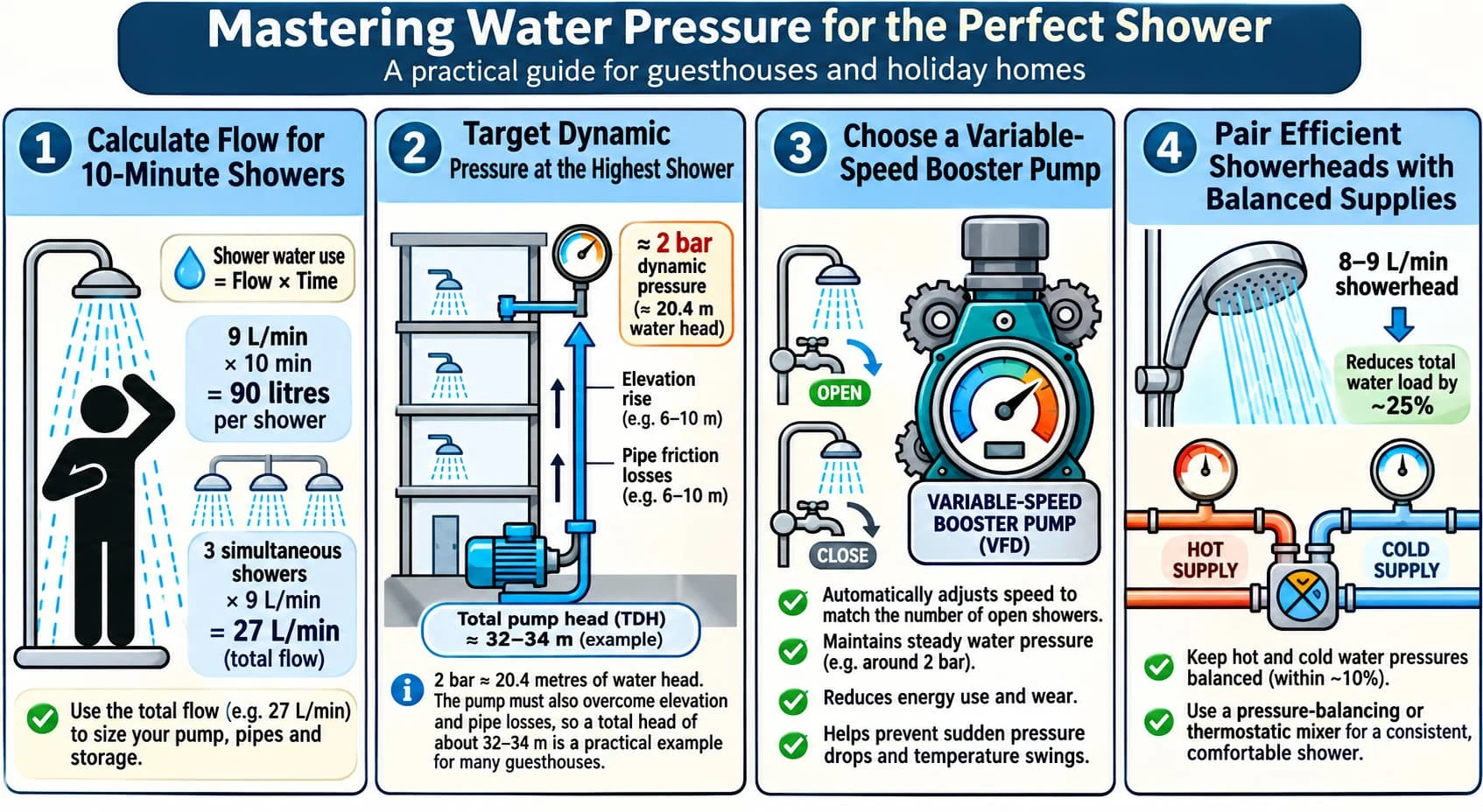
At 9 L/min, a ten-minute shower uses about 90 litres. Three showers running together use 27 L/min before you count basins or other outlets.
A gauge reading with every outlet closed measures static pressure. Measure dynamic pressure while water is flowing, including at the most demanding shower during peak use. Check the showerhead manufacturer’s published flow at that pressure. Different spray designs can deliver different flows at the same pressure.
Pump head describes the energy the pump adds, expressed in metres of water column. The system uses part of that head to lift water and part to overcome losses in pipes, elbows, filters and valves. The remainder determines the pressure available at the outlet.
2. Estimate How Many Showers Run Together
Five guest rooms with en-suite bathrooms could draw 40–50 L/min if all five showers run together at 8–10 L/min. Whether to design for that peak depends on how guests use the property. A corporate guesthouse with a common departure time may see a sharp morning peak. A leisure homestay with flexible breakfasts may see demand spread over several hours. For related examples of how guest schedules vary, see why flexible stay options matter.
| Showers running | At 8 L/min each | At 10 L/min each |
|---|---|---|
| 1 | 8 L/min | 10 L/min |
| 2 | 16 L/min | 20 L/min |
| 3 | 24 L/min | 30 L/min |
| 4 | 32 L/min | 40 L/min |
| 5 | 40 L/min | 50 L/min |
In this example, three showers at 9 L/min total 27 L/min. Use approximately 30 L/min as the rounded shower design flow. Ask the installer to account for other concurrent outlets and verify the expected peak. A fourth or fifth shower could reduce flow or pressure. Decide what performance guests should receive when the property is fully booked.
3. Calculate the Required Pump Head
Assume the highest shower is 8 metres above the booster. Target 2 bar at that shower at the design flow and allow an illustrative 0.3–0.5 bar for losses along the supply path.
- Outlet pressure head
- 2 bar ≈ 20.4 m
- Elevation head
- 8 m
- Pipe and component losses
- 0.3–0.5 bar ≈ 3.1–5.1 m
8 + 20.4 + (3.1–5.1) = 31.5–33.5 m.
For preliminary planning, specify about 30 L/min at 32–34 m of head.
This calculation assumes the booster supplies the full increase. Have the installer verify the inlet conditions and calculate actual losses at the design flow. Positive inlet pressure from a raised tank can reduce the head the booster needs to add. Check available pressure at the lower floors as well.
4. Check the Pump Curve at the Required Duty Point
Two pumps with identical motor ratings can deliver different combinations of flow and head. A pump advertised at 40 m maximum head may deliver that head at or near zero flow. Its maximum flow is measured at a different point on the curve.
Look for the manufacturer’s Q–H curve, which plots flow (Q) against head (H). At 30 L/min, read up to the curve and across to the head axis. Check that the pump can meet the target within the manufacturer’s recommended operating range. The actual operating point depends on the system and the controls. Grundfos guide to pump curves.
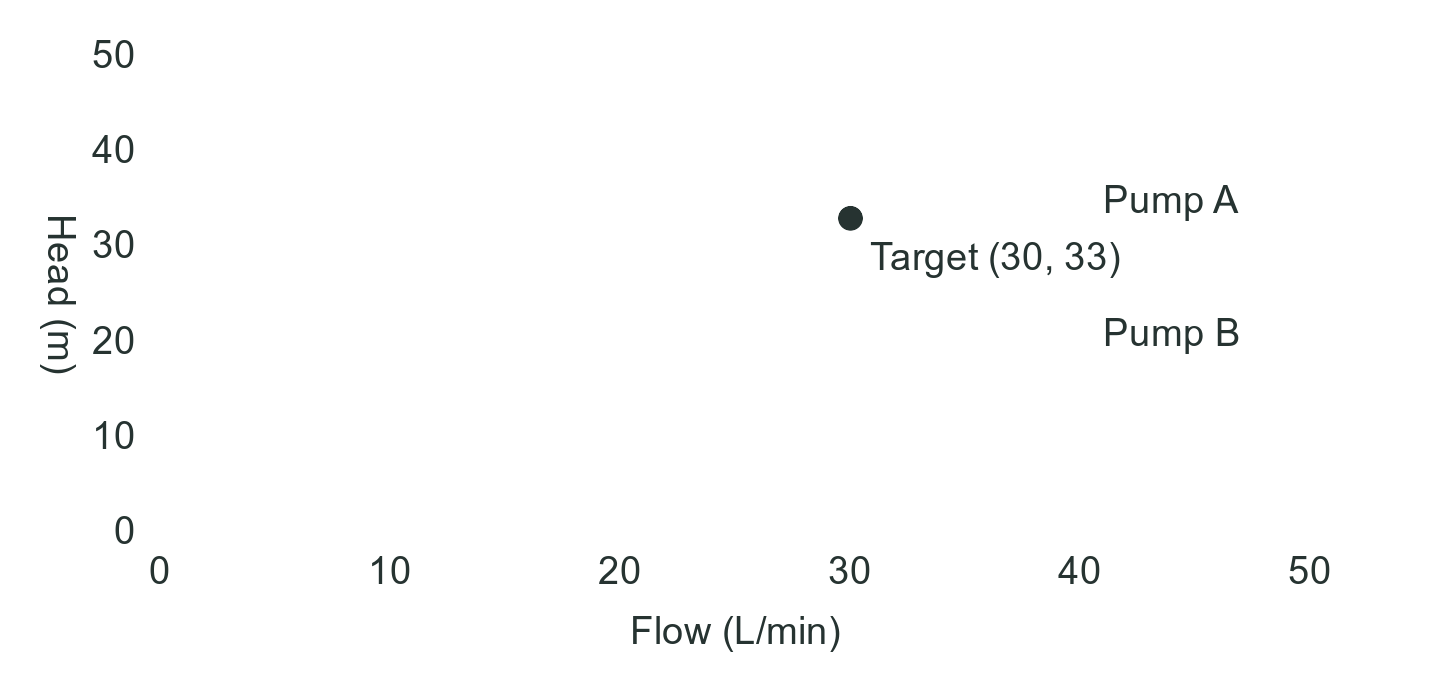
Can you recommend a booster capable of delivering about 30 litres per minute at 33 metres of head? Please mark that point on the manufacturer’s curve and explain how the pump handles variable demand.
5. Compare Fixed-Speed and Variable-Speed Boosters
Fixed-speed systems
A fixed-speed pump runs at a set speed when switched on. Controls and a correctly sized pressure vessel can manage start and stop cycles. This can be a simpler and less expensive option. Check the pressure range guests experience as the pump cycles and how often the unit starts under light use.
Variable-speed systems
A variable-speed booster adjusts its speed as demand changes. With suitable controls and sizing, it can deliver more consistent pressure as showers open and close. It can reduce cycling and may save energy under suitable operating conditions. Compare upfront cost, low-flow performance and local service support. Grundfos guide to constant-pressure boosting.
For the five-room example, a variable-speed booster is a reasonable starting point for quotations. A well-designed fixed-speed system can also meet the service target. Ask both suppliers what happens at one shower and at the expected peak.
6. Balance Hot- and Cold-Water Supplies
A shower mixer needs compatible hot and cold supplies. If the cold side is boosted and the hot side comes from a separate gravity-fed tank, the pressure difference can affect flow and temperature, especially when other guests open outlets.
Cold supplyStorage → domestic booster → cold branch → mixer
Hot supplyCompatible supply → rated solar or other heater → hot branch → mixer
Optional hot-water returnHot distribution → circulation pump → heater return
Have a qualified installer verify the heater and storage pressure ratings, expansion protection, and requirements for valves and temperature controls. This is particularly important with solar water heating. A pressure-balancing or thermostatic mixing valve may help when specified for the actual inlet conditions. Where hot-water recirculation is needed, size and control that loop separately.
7. Worked Example for a Five-Room Guesthouse
| Parameter | Illustrative value |
|---|---|
| Guest rooms and bathrooms | 5 of each |
| Showers running at peak | 3 |
| Flow per shower | 9 L/min |
| Combined shower demand | 27 L/min |
| Rounded design flow | About 30 L/min |
| Target dynamic shower pressure | 2 bar |
| Highest shower above booster | 8 m |
| Assumed plumbing losses | 0.3–0.5 bar |
| Required pump head | About 32–34 m |
| Motor range to investigate | 0.75–1 HP, subject to the pump curve |
| Control approach to evaluate first | Variable-speed booster |
Give each supplier the same duty point. Ask for the model’s full performance curve, its control settings and an explanation of how it would behave during peak and light use. Account for washbasins, cleaning outlets and other loads before confirming the final specification.
8. Use Showerhead Selection to Manage Demand
Three 12 L/min showerheads draw 36 L/min. Three 9 L/min models draw 27 L/min, a 25% reduction. That can reduce the load on the booster, storage tanks and hot-water equipment. For the wider cost picture, see how to calculate short-term rental profitability in India, including utilities and maintenance.
| Flow per shower | Total water used |
|---|---|
| 12 L/min | 360 litres |
| 9 L/min | 270 litres |
| Difference | 90 litres |
Try the spray at the intended operating pressure. For this example, 8–9 L/min is a starting point for evaluating showerheads that deliver a spray guests will be comfortable using.
9. Avoid Common Installation Problems
- Undersized pipework
- Calculate friction losses using the expected flow, pipe length and fittings. Check the existing distribution before deciding the pump needs replacing.
- Inadequate inlet supply
- Check that storage and suction pipework can feed the pump at peak demand. Specify suitable dry-running protection.
- Poor pressure control
- Set the controls for the intended service range. Verify vessel sizing and pre-charge where a pressure vessel is used.
- Incompatible hot-water equipment
- Have the installer verify pressure ratings, expansion protection and temperature controls before connecting a booster.
- Limited service access
- Leave room to inspect and service the pump, strainer, valves and controls.
10. Owner’s Checklist Before Buying
Property and expected demand
- Room and bathroom counts, floor levels and highest shower elevation above the pump
- Likely simultaneous showers and any other outlets used during the peak
Existing or planned water system
- Water storage location, available inlet pressure, pipe sizes and route lengths
- Hot-water equipment and storage, including any return loop
- Showerhead flow and pressure requirements
Supplier quotation
- Required flow and head marked on the manufacturer’s Q–H curve
- Control strategy, electrical requirements and dry-running protection
- Warranty, service availability and spare parts
On a new property, settle these details before concealing the pipework. At an existing property, ask the installer to measure flow and pressure under load and check filters, valves and the inlet supply before quoting for a replacement.
11. Free HostHelper Pump Sizing Calculator
The planned calculator will use expected simultaneous showers, flow per shower, elevation and target pressure to estimate preliminary flow and head for a discussion with your installer or supplier.
12. 90-Second Explainer
Listen to this 90-second explainer on choosing the right water booster pump for your guesthouse. Understand the relationship between water flow, pressure and pump head, why simultaneous shower usage matters, and how to avoid common pump-selection mistakes.
Final Thoughts
For the five-room example, start the supplier conversation at 30 L/min at 32–34 m of head. Ask the installer to verify simultaneous demand, inlet pressure and pipe losses, then confirm dynamic pressure and temperature stability at the highest shower during commissioning.